

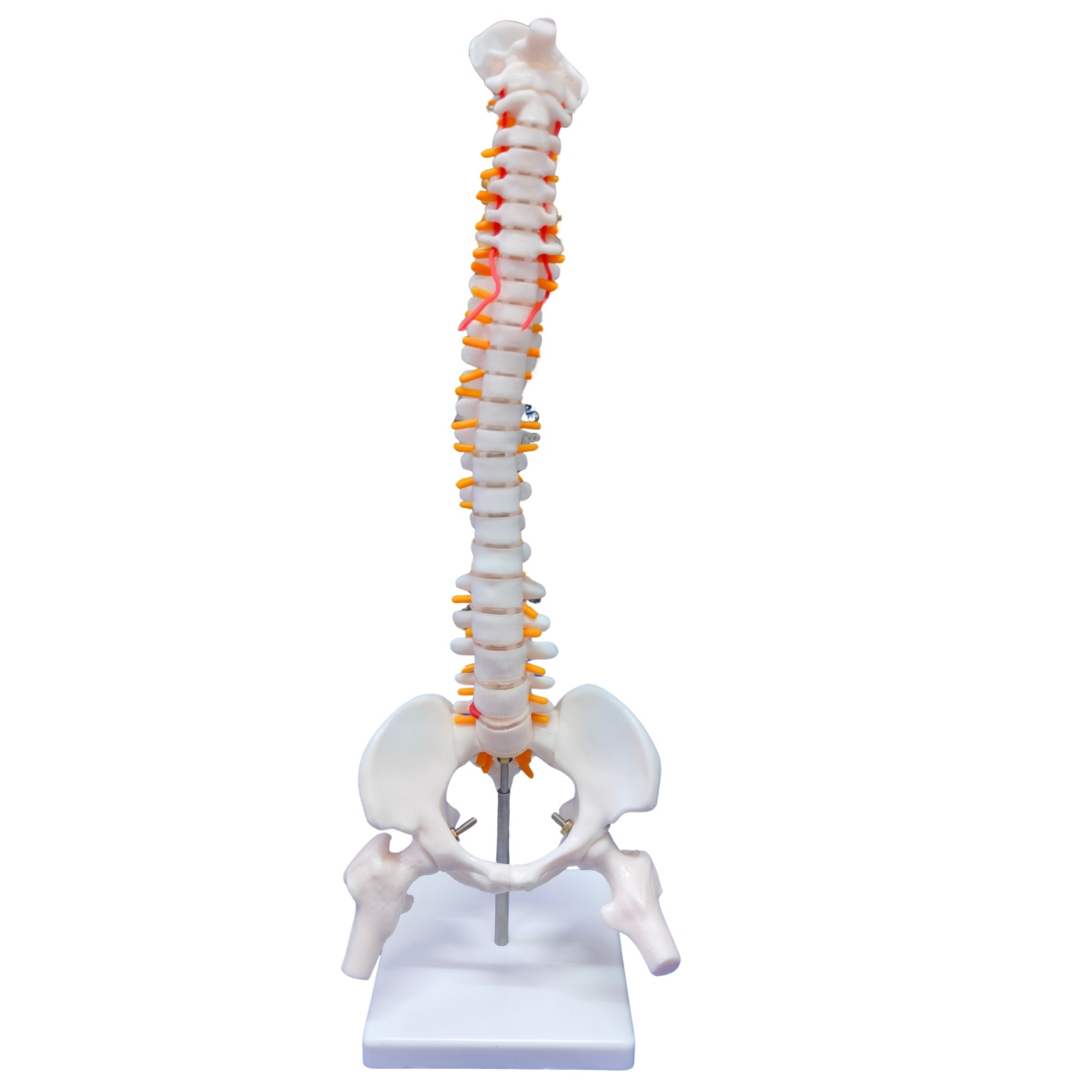
K-Star Human Mini Spine Model (42 cm) with Femur Head
Flexible Vertebral Column Anatomy Model for Medical Education, Chiropractic Training, Orthopedic Study & Biology Laboratory Demonstration
The K-Star Human Mini Spine Model (42 cm) with Femur Head is a professionally designed anatomical teaching model that provides a detailed representation of the human vertebral column in a compact and practical size. Developed for medical education, chiropractic training, orthopedic demonstrations, physiotherapy instruction, nursing education, biology laboratories, and healthcare learning, this model offers exceptional anatomical accuracy and educational value. Made from premium-quality PVC, the model features individually detailed vertebrae connected with a flexible structure that demonstrates the natural movement and curvature of the cervical, thoracic, lumbar, sacral, and coccygeal regions of the spine. This flexibility enables realistic demonstrations of spinal alignment and posture during classroom teaching and patient education.
The model also includes a detailed pelvis, sacrum, coccyx, and femur heads, allowing students and healthcare professionals to study the relationship between the spine, pelvis, and hip joints. Its compact 42 cm size makes it easy to carry, store, and display while still providing clear anatomical detail for effective learning. Ideal for medical colleges, nursing institutes, chiropractic clinics, orthopedic departments, physiotherapy centers, biology laboratories, healthcare training programs, and educational institutions, this model serves as an excellent visual aid for explaining spinal anatomy, vertebral alignment, posture, and skeletal structure.
The durable construction ensures long-lasting performance even with frequent classroom demonstrations and practical sessions. Whether used by students preparing for examinations, instructors conducting anatomy lessons, therapists educating patients, or healthcare professionals delivering training, the K-Star Human Mini Spine Model provides reliable educational support. Its lightweight and portable design makes it suitable for workshops, seminars, clinical consultations, and laboratory demonstrations. Combining anatomical precision, flexibility, durability, and convenience, the K-Star Human Mini Spine Model (42 cm) with Femur Head is an essential learning tool for anatomy education and professional healthcare training.
⭐ Key Features :
🦴 Realistic Human Vertebral Column
Accurately reproduces the human spinal column with detailed vertebral anatomy.
🔄 Flexible Spine Design
Allows realistic demonstration of spinal movement and natural curvature.
🦵 Includes Pelvis & Femur Heads
Features anatomically accurate pelvis, sacrum, coccyx, and femur heads for comprehensive anatomy learning.
🎓 Professional Medical Teaching Aid
Ideal for anatomy education, chiropractic instruction, orthopedic study, and physiotherapy training.
💪 Durable Premium PVC Material
Manufactured from strong, high-quality PVC for long-lasting educational use.
📏 Compact 42 cm Size
Portable and easy to handle for classrooms, clinics, and laboratories.
🏥 Suitable for Clinical Demonstrations
Useful for patient education and healthcare training.
👨⚕️ Educational & Professional Quality
Designed for students, educators, therapists, and healthcare professionals.
⭐ Benefits :
🌟 Enhances understanding of spinal anatomy
🌟 Demonstrates natural vertebral movement
🌟 Supports chiropractic and orthopedic education
🌟 Excellent physiotherapy teaching aid
🌟 Ideal for biology and medical students
🌟 Durable for repeated educational use
🌟 Compact and portable design
🌟 Improves visual learning and demonstrations
🌟 Professional-quality anatomical model
🌟 Suitable for classrooms, clinics, and laboratories
⭐How to Use K-Star Human Mini Spine Model (42 cm) with Femur Head :
The K-Star Human Mini Spine Model (42 cm) with Femur Head is an educational anatomical model designed for teaching, learning, and demonstrating the structure of the human vertebral column. It is suitable for medical education, chiropractic training, orthopedic study, physiotherapy instruction, nursing education, biology laboratories, and healthcare demonstrations.
⭐ Step 1: Unpack the Model
🦴 Carefully remove the spine model from its packaging.
✔ Check that all components are intact.
✔ Ensure the spine, pelvis, sacrum, coccyx, and femur heads are securely attached.
✔ Handle the model gently to maintain its anatomical structure.
⭐ Step 2: Place on a Stable Surface
🏫 Position the model on a flat, stable surface or display stand (if included).
✔ Ensure the model remains upright.
✔ Place it in a well-lit area for clear observation.
✔ Keep it accessible for demonstrations and study.
⭐ Step 3: Study the Vertebral Column
📚 Examine the different sections of the spine:
✔ Cervical Vertebrae
✔ Thoracic Vertebrae
✔ Lumbar Vertebrae
✔ Sacrum
✔ Coccyx
✔ Pelvis
✔ Femur Heads
Observe the natural curves and alignment of the vertebral column.
⭐ Step 4: Demonstrate Spinal Flexibility
🔄 Gently move the flexible spine to demonstrate:
✔ Forward bending (Flexion)
✔ Backward bending (Extension)
✔ Side bending (Lateral Flexion)
✔ Natural spinal curvature
✔ Vertebral alignment
Do not apply excessive force while bending the model.
⭐ Step 5: Explain Anatomical Structures
👨⚕️ Use the model to demonstrate:
✔ Individual vertebrae
✔ Pelvic anatomy
✔ Hip joint relationship
✔ Sacral and coccygeal regions
✔ Overall spinal structure
✔ Basic posture and spinal alignment concepts
⭐ Step 6: Educational Applications
🎓 Ideal for:
✔ Medical education
✔ Chiropractic training
✔ Orthopedic demonstrations
✔ Physiotherapy instruction
✔ Nursing education
✔ Biology laboratory practicals
✔ Anatomy classroom teaching
✔ Healthcare training programs
⭐ Step 7: Patient Education
🏥 Healthcare professionals can use the model to:
✔ Explain spinal anatomy.
✔ Demonstrate posture and spinal alignment.
✔ Educate patients about the vertebral column and pelvis.
✔ Support anatomical discussions during consultations.
⭐ Step 8: Storage After Use
📦 After completing demonstrations:
✔ Place the model in a clean and dry location.
✔ Protect it from dust and direct sunlight.
✔ Avoid placing heavy objects on the model.
✔ Store carefully to maintain its shape and flexibility.
⭐ Benefits During Use :
🌟 Improves understanding of spinal anatomy
🌟 Demonstrates realistic vertebral movement
🌟 Supports medical and healthcare education
🌟 Excellent visual learning aid
🌟 Ideal for chiropractic and orthopedic teaching
🌟 Compact and portable for easy demonstrations
🌟 Durable construction for repeated use
🌟 Suitable for classrooms, clinics, and laboratories
🌟 Enhances anatomy learning and practical training
🌟 Professional-quality educational model
⭐ Care Instructions :
🧼 Wipe with a soft dry or slightly damp cloth.
✔ Do not use harsh chemicals or abrasive cleaners.
✔ Handle the flexible spine carefully.
✔ Avoid dropping or excessive bending.
✔ Store in a cool and dry place.
⭐ Safety Precautions :
⚠ Educational model only.
⚠ Not intended as a toy.
⚠ Handle with care to prevent damage.
⚠ Keep away from excessive heat and moisture.
⚠ Adult supervision is recommended during classroom demonstrations.
Available At :
K-STAR INDIA (Khandoliya Industries)
➡️ Acupressure & Acupuncture | Physiotherapy | Panchakarma & Magnet | Cupping & Hijama | Product & Equipment
📍Address: Shop No. 3, Near Gurudwara Road, Opposite Union Bank, Block 6, WEA, Karol Bagh, New Delhi – 110005.
📞Contact: 9560379805, 9413023521
9625359462, 08048033068
🌐 Website: www.kstarindia.com
🌐 www.acupressuredelhi.com
📍 Google Map: https://share.google/RxxycSz348HpcxxVm
**Choose Khandoliya Industries — A Name You Can Trust in Natural Wellness.**